Showing posts with label tdc15. Show all posts

Tuesday, 2 June 2015

Thinking Digital Wrap Up

Hello!


For this post I thought I'd wrap up my Thinking Digital 2015 experience in one handy post, with links, top takeaways and all that jazz. I was able to listen to some thought leaders in the digital landscape. Speakers included professors on machine learning, hacktivists, startups and even a Technical Director from Pixar.


Whilst I could exhaustively list off everything I learned at the conference it'd likely be a very long list of nerdy things that may not make for the most interesting blog post. So as a happy alternative I'll leave the link to the sessions which you can view in full, including the Reframed.tv comments.


So, what did I learn?

The digital future:
  • There is a serious boom in the tech market and it's only going to continue to grow; whilst Moore's law may be proving true at the moment, physics say that advancement has to slow from it's current rate.
  • Digital solutions are continuing to replace tasks undertaken by people - automation is going to continually improve efficiency
    • An unforeseen impact of an automated future is the impact on the job market - if we all live in a digital world automated by machines, how will people earn a living?
  • The digital future ran by machines may not necessarily be what we imagined from 'The Jetsons'.
    • Robots will be part of our daily life, but then again they already are. A Roomba for all intents and purpose is a vacuum robot, it is capable of doing one task, automatically, and to a high standard. Whilst the Roomba is a robot that can 'think' it is not able to think of anything other than the task it was designed for.
      • The Roomba is not going to make you a cup of coffee, nor is it going to try to kill you whilst you sleep.
      • Our robotic and automated future will consist of many machines that can do a limited set of jobs, but do them quickly and to a high standard

Agile principles are spreading:
  • Most speakers alluded to agile development without mentioning the process outright
  • The idea of iterative development of services is exciting to many as they can interact with customers during the process to help them build a product consumers actually want
    • If you build a product, are you sure your targeted customer wants it? If they do, does your vision match their needs?
      • It is better to find out what your customer requires and use their needs to develop a product throughout the development process as opposed to finishing a masterpiece that nobody wants.
  • Consistent user testing allows creators to understand their choices, whilst not everyone can test, everybody should be invested in the outcomes of the research
  • The Government Digital Service envisages a future where a service becomes a platform unto itself with functional services.


Boring is awesome:
  • Linked to the agile principles, boring is awesome and should be a basic goal for everyone. When you think about what boring is; is it actually a bad thing?
    • Boring things work exactly how you think they do
    • Boring things are reliable
    • Boring things have no nasty surprises
    • Boring things are accessible
    • Boring things have an easy point of entry
    • Boring caters for an essential need
  • We could make a really cool interesting product that was half functional and really complex, but would that suit our customer?
    • I’d rather have a functional Nokia 3310 than a faulty Blackberry, would you?
  • Just because something is boring does not mean it can’t become more interesting and exciting down the line,

STEM education is going to explode:
  • STEM is growing at a fantastic rate within schools with coding being pushed front and centre combined with the Internet of Things.
  • A problem that has previously stunted the growth of coding in schools is finding a method to truly engage students and teachers. Showing physical changes such as lights changing colour, robots moving or even live coding music can help engage and motivate everyone to code.
  • STEM education is going to become more diverse with teachers and students gaining access to new tools and free open source programmes to encourage to get involved in coding.
    • With this in mind it is clear that ed tech companies may need to review their approach to STEM assessment and cater for the new classroom.

Play with everything:
  • If you can do it, why not?
  • In direct contradiction to what I said earlier, maybe boring isn’t so good. Maybe we should play with everything and be open to experimenting with concepts, tools and theories to see things in new ways. For example, data visualisation can be shown in incredible ways if we just separate ourselves from conventions.
    • 3D printed jewellery of the weather forecast?
    • Facebook interactions charted and interpreted into a hopscotch board
  • Small playful changes help you stand out from the crowd.
    • Basic experimental tweaks to UX can engage a customer competitors don’t
      • A hidden animated owl on a website added mystery and kept user engagement to ensure visitors stayed on that webpage
  • Subverting expectations whilst meeting all criteria to provide a service can unlock a new engaged and loyal customer base.
    • Google’s doodles, how many times do you click on a doodle to learn something about a subject you know nothing about
    • #LJTunes mashes together songs with contrasting genres to bring new music to life
  • Whilst you can play with products, expectations and services, don’t forget to have fun within your teams. A positive competitive atmosphere allows individuals to excel.
  • A key point to remember is to try and enjoy what you do as it will be a good tool to get others to buy in. Just do it, and if it doesn’t work try something else.

So there we go; an awesome, inspiring and intelligent conference highlighting how individuals will interact in the future. Tech is spreading but the principles behind the growth remain familiar:
  • Build with the customer in mind
  • Be flexible
  • Experiment
Thanks for reading!
AT

Sunday, 24 May 2015

Thinking Digital: Part Three, Agile-ology

Hello!

This post is a special one in that it links Thinking Digital (#tdc15) with the actual topic for this blog, agile!

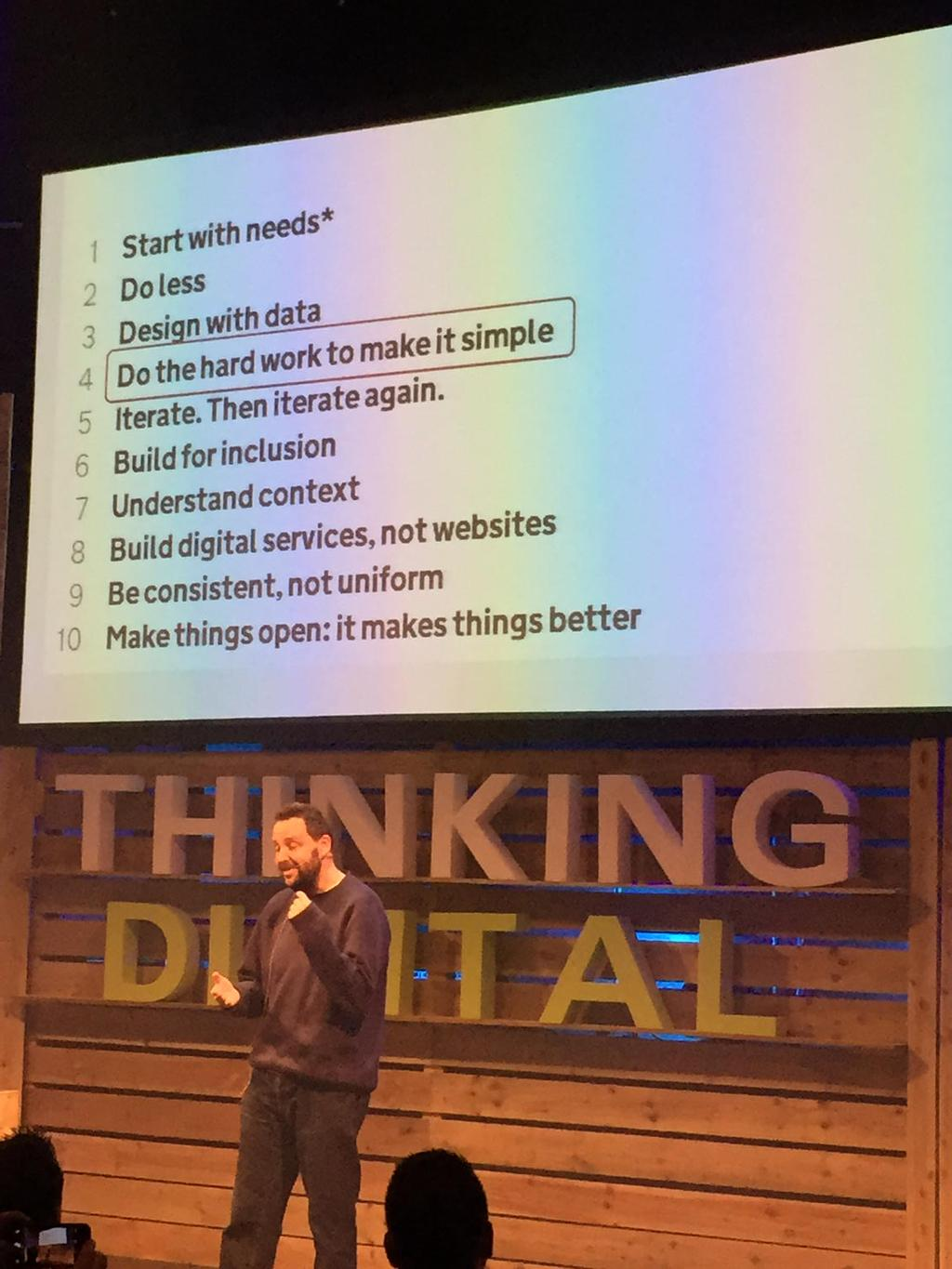
Whilst there were speakers at the event who brushed on agile and scrum methods, the head of the Government Digital Service held a joint presentation on how they've updated the entire government digital system to be a fully accessible interactive platform.

Russell Davies (@undermanager) is a self proclaimed GDS Jedi with a background in advertising agencies working for clients such as Nike, Apple and Honda, including that Honda advert.

He is currently Director of Strategy at the Government Digital Service - working out how a Digital Government integrates its products, services and marketing - thinking beyond government as a website and figuring out how we deliver Government As A Platform.

Davies starts with a simple statement, 'The strategy is delivery'. The product required was a platform for the Government Digital Service and with Gov.uk they built a platform for publishing that has over 12 million users every week. The platform built to confirm identity has 19,000 authentications per week alone.

As the civil service is under constant scrutiny the team must prove the value of the new digital services. Davies believes the team is already achieving this. With the creation of the digital marketplace of skills government vendors can be sourced more efficiently from local sources. Removing the London-centric bias of the civil service will take many years but by moving services to a neutral online location goes a long way to help this. The implementation of the new digital platform may cause some stress but it will save billions.

Now that they've justified the case to build to stakeholders the team have embraced an agile concept. ‘No innovation until everything works’. The Gov.uk website is boring, by choice. The team would rather have a fully functioning product that can achieve all basic functions required by the users is far more desirable than an impressive but heavily niched site. The Gov.uk team ensures full functionality of a feature before moving on to something else, essentially the function must be signed off as 'done done' by all stakeholders, something critical for a government website.

Ensuring that the new functions are supported is incredibly important, Davies brings up how many cash machines are having to have costly patches added to them as they cannot upgrade past the no-longer supported Windows XP. This is not acceptable for a state website and as a result they have developed core principles to ensure this kind of situation never befalls them.


In keeping with these principles the Government Digital Service has made the surprising choice to actually make all their code open source on GitHub, perfect if you decide you need to start your own country and require a complete digital service solution...

This openness is important in agile, becoming transparent and quick to act allows quick change and more honesty, something that can only improve perceptions of not only governments but business too.

The team behind Gov.uk strain to have user centric design, and whilst it may appear boring, boring is fantastic. Boring works, boring is simple and boring allows users to understand a system fully.

Ade Adewunmi works alongside Davies and is the driving force to push Government as a Platform. Adewunmi is central to GDS’s emergent strategy approach: that only by prototyping is it possible to create digital products and services in a way that matches the realities of delivery. And that just like digital services, strategies need to be iterated. She believes that the best way to get results is Revolution, not evolution.

Before we start worrying about revolutionaries in the heart of the digital government wanting to start a new world order, Ade refers to revolution in the way she aims to push new processes. Revolution describes the rapid culture change needed, rather than slowly move a tanker around to reach a destination, blow it up and use a nippy speedboat to get there!

That's not to say evolution has no place, as obviously agile as a method relies on the constant revision and improvement of a core, the evolutionary process helps test features and refine the culture however upheaval may be required to ensure buy in.
The Gov.uk team has:
  • Delivered a lot
  • Learned a lot
  • Changed a lot

By focusing on the user journey the team has built a new system, it was rigid where it had to be and flexible where it allowed. The user's journey, from end to end was reviewed constantly by researchers who helped inform the development team what worked and what would not. By opening the system and ensuring open standards, the team had flexibility with an added consistency across each project. This was critical for a large scale, multi stakeholder service development.

This links on to the roadmap, by being completely open in practices with stakeholders the team has delivered everything required and everyone is aware of how. Stakeholders and usability are core to this, with the teams not allowed to move on to mobile apps or cool interesting features until the core system works fully.

Under Adewunmi there have been core open standards which have worked when:
  • They are made clear and responsive
  • Support us provided and the standards enforced
How does Adewunmi see the future? Government as a platform
The Government Digital Service will strive to ensure everything they build is a service or platform, not just a website.
As a parting piece of guidance Ade tells us to ask ourselves some questions whenever we build something;
  • What are you building?
  • Why?
  • How can it be improved?

The story of the GDS is inspiring and shows what can be done with agile, whilst also offering practical advice to ensure you get the most from your agile projects. A fantastic talk by two great speakers, and an excellent session at Thinking Digital.

Thanks for reading!
AT

Saturday, 23 May 2015

Thinking Digital: Part Two, Innovation Street

Hello!

For the next part of my Thinking Digital 2015 breakdown I'm looking to review the speakers who spoke on innovation. Now most if not all the speakers spoke on innovation, so to narrow the field and make this blog post smaller than 100,000 words I'm focusing on innovation in the home and local spheres.


There was no better speaker on home innovation and making the Internet of Things accessible to individuals than Andy Stanford Clark. Currently a visiting professor at Newcastle University and a master inventor at IBM, Andy has shown incredible creativity and invention approaching problems with insightful and fun solutions.


The talk consisted of trying to understand life's problems or things you wish to achieve and from there review how you can achieve your goals, from solutions to eliminate the mundane and improve lifestyle, to time and money saving systems with actual impact on human lives.

One of the core conceits of the talk was that innovation truly begins at home, Andy's own ingenuity was sparked as a child when attached a moisture detector to a buzzer and hung it outside on his washing line at home. This was so that whenever it would rain the buzzer would sound to alert the people in the house to bring the laundry in.

Andy argues throughout his talk that we have reached a point now where it is easy for anyone to make a computer and understand how to create devices and functionality through logic. Computers are now cheap and accessible to vast swathes of people, the Raspberry Pi computer allows for a simple coding interface with its low price making it an easy point of entry.


The talk continues where Stanford Clark shows how innovation can be used in a world embracing an Internet of Things slowly leading us to where it can actually significantly impact people's lives. Using a simple computer you can create an electricity usage calculator which can allow individuals to work out how much money they're spending on appliances throughout the year. Created in a classroom with a raspberry pi and a ping pong ball with watt detector the 'Orb of Awesome' changes colour depending on how much energy is being used. Whilst these devices already exist Stanford Clark shows that this is just one area which can be improved on and often more importantly, provide direct agency to those involved to make them engaged. He has even taken this further by automating a Twitter feed directly from his house which documents his energy usage on a daily basis. Through his own tinkering Andy discovered that the clock in the microwave actually consumes more energy throughout the year than the function the appliance was designed to do.

With the new internet of things we have the ability to create many functions at different levels. With more accessible technology we must bear in mind the following:
  • Instrumented
  • Interconnected
  • Intelligent
With the data collected we achieve actionable insight to help design systems to help people. This can be through time saving, saving money or automating the world to make it much more interesting. It turns out you can build a better mouse trap, Andy did, and when it triggers it sends a grave stone emoji to his phone.


Using this technology on a wider scale can let people know when a ferry arrives, when aid arrives to a natural disaster or just how to save money on a fuel bill. We are entering a new age of innovation, and everyone can get involved.


Tony Hey continued the theme of innovation by charting the ages of technology. Hey argues that there have been three ages of computing.
  • 1950s
    • Simulation
      • ENIAC- massive military machine
      • Communication in simulation era
      • IBM mainframe era
      • Computers are the size of tanks
  • 1980s
    • Communication
      • Personal computing
      • Connection to printers
      • Personal programming
      • Precursor to home computers today
      • Killer app - spreadsheets
      • Communication killer app - email
    • Second step within the age
      • Internet
      • Use of system to complete function
      • Communication is important in what it leads to
      • Natural progression from Moore’s law of natural growth
      • New algorithms and natural growth
  • 2010s
    • Simulation 
      •  Internet driven cars
      • Assisted technology
      • Automated systems on existing infrastructures
      • Gathering actual insight from data as opposed to data collection
      • Algorithms become even more intelligent
In 1971 first microprocessor was created for a calculator, when it was ordered the calculator company asked for a different type of chip in each calculator, however the designers decided to be more ambitious whilst saving money at the same time, they decided to insert the same chip in each calculator, just program it in different ways. The way the chip worked allowed each system to utilise it differently, despite being able to be utilised in different ways, the chip itself was not intelligent.

Hey leads us on to the topic of AI and the possibilities within. Is it strong or weak? Is artificial intelligence capable of intelligent design - analysis and insight? Hey argues it is more likely to only be capable of brute force, in that it can do simple logical tasks well and do them fast, however it can't actually think, imagine it if you will as a passionate photocopying clerk as opposed to an executive.

IBM Watson won Jeopardy! but it had no idea it had won, as it does not understand the concept of winning. Automation is not intelligence. Is it conceivable that we create a self aware AI? It is incredibly unlikely but not impossible. Hey argues that Moore’s law cannot go on forever, physics say it will fizzle and level out with us reaching the peak of robotic innovation and automation soon.


More updates from my Thinking Digital experience soon!
AT

Thursday, 21 May 2015

Thinking Digital: Part One

Hello!

This week I was fortunate to enough to win tickets to Thinking Digital 2015 as part of SageOne's social media team. Essentially I got a free ticket to a really cool festival to tweet along, interact and blog... What I'd be doing anyway! So how was it?

Well I can safely say that it was one of the best conferences I've been to with a diverse selection of speakers catering to areas I'm incredibly interested in already. Highlights of the conference included talks from all kinds of people from heads of start ups to academics and managing directors to artists, everyone is impacted by our digital world so so many people are able to speak. This created a huge pool of depth in not only across the topics featured and also allowed the audience to get a good insight with more information to pursue if they choose. The talks are in bitesize chunks, similar to TED giving a speed and efficiency to the event.

Held at the beautiful Sage Gateshead, a building I'm ashamed to say I wasn't so keen on when it was being built as I thought it looked a bit like a jelly sweet that had the bursting jelly inside if I was being kind, or a maggot if I was being crude.

So, enough on the set up, let's get on to the themes and speakers, for each speaker I'll pull their description from the Thinking Digital site with a brief breakdown and impression of their talk:

Image result for portal 2 wheatley
  • Luciano Floridi is Professor of Philosophy and Ethics of Information at the University of Oxford, where he is the Director of Research and Senior Research Fellow of the Oxford Internet Institute, Governing Body Fellow of St Cross College, Distinguished Research Fellow of the Uehiro Centre for Practical Ethics, Faculty of Philosophy, and Research Associate and Fellow in Information Policy of the Department of Computer Science.
    •  Kicking off with a bang, this talk was possibly one of the most information rich and interesting. Floridi explains that the concept of robots have been around for millenia however we need to define what robots are and what we actually hope to achieve by creating robots.
    • When we think about robots in the current landscape we are inspired by science fiction and the thoughts that enchant us and stay in the common consciousness are those that challenge us or shock culture. This is why HAL endures in the popular consciousness, because although HAL becoming self aware is unlikely, it's still a striking thought...
    • Floridi argues that we should not be worried about AI and the singularity, comparing the subject to ghosts, as a scientist they cannot disprove ghosts so the idea will pervade.
    • Floridi enters a thought experiment and creates his self aware AI from the singularity and nicknames it AI-Zilla, if this system were created would this spell a dark time for the human race? Well yes, pretty much, however if the four horsemen of the apocalypse appeared overnight we would be in a very similar position, Floridi posits that both situations are as likely as each other.
    • Labouring the point further, Floridi argues that the self aware malevolent AI is the 'Nigerian Prince email' of the subject in that it's an annoying concept that keeps appearing in the discourse. 
    • Floridi's primary concern regarding AI and robots is not an evil robot enslaving humanity, at least ideologically.
    • If you review robots as a very basic worker with predetermined labour limits this view becomes far more interesting. A Roomba is an automated AI vacuum cleaner, it is for all intents and purposes a cleaning robot, however this does not mean your Roomba is going to be able to make you a coffee let alone become self aware and kill you whilst you sleep in a fit of revenge...
    • However as we develop more robots to do more tasks, we will impact the job market eliminating jobs once held by humans and giving them to automated systems. The job that would take 15 workers to do could be done by robots, supervised by one engineer. We are finding more and more ways of automating tasks using big data and robots, this will lead to growth, however growth of what? Jobs may decrease and automation increase, is this what we want?
    • Floridi argues that safe is always better than sorry, however in the realms of AI is there anything that could actually make us sorry? He doesn't think so, therefore why don't we play around with robotics and automation
    • Is AI possible? There has not been a great leap forward since the creation of the Turing test, however those who attempt the Turing test must be reviewed and have those administering it actually understanding the point. For example if you ask a computer if it believes in God and it answers 'no', this is not showing intelligence, it is showing that the computer does not believe in the concept of God. If a computer says it is not afraid of the dark it does not show that the computer feels a fear, it shows that it is incapable of fear.
    • If AI is coming, and by AI we mean computers that can pass the Turing test, when do we anticipate it?
      • 2000 - 50 years from paper published in 1950 by Turing
      • 2018 - oh I suppose it'll be done by then
      • 2028 - I’ll be 80 by then, and it’ll happen by then
      • 2115 - Hawking ‘I’ll be dead by then’ 
    • We now live in a more connected world with a growing population, however whilst people increase in number, the amount of devices online, currently we think of mobile phones, tablets and laptops however as the Internet of Things grows we will have many robot assistants and devices interacting with us in daily life.
      • For example a dishwashing robot is most likely to be linked directly to dishwasher than a dishwashing robot maid
       
    • 4 Real Challenges facing us when we think about AI:
      • Replaceable agency
        • Interface between tasks will cut job market
        • Humans are replaceable - 10 jobs can be done by one person with automated assistance
        • Will we introduce legislation to protect jobs?
    • Predictable freedom
    • Influential autonomy
      • Amazon suggests what you like, automating choices and trends
    • Dependent delegation
      • Moving to an urban population, becoming dependant on machines
    • With all this in mind, we are now in a architectural generation and must define the course we tread in the future asking ourselves 'What kind of society do we want to build?' We need to understand how things work, from robotics to emotions, we need to understand all we can. Floridi's advice for this:
      • Think deeper
        • Through learning and creating philosophy
      • Design better
        • Think how it can be used and how it will be impacted
      • Be mindful
        • Think ahead as to how what we do now will be remembered and impact us, we’re in this for the long haul
    • It was a fantastic talk and I'm inspired to learn more about our evil robot overlords, I mean, slightly sinister robot desk clerks.
Hope you've enjoyed reading this so far, I will have more breakdowns in the coming days...
 

Cheers,
The Digital Thinking, Robotically Integrated Agile Timelord

Tuesday, 19 May 2015

Special Bonus Round! Thinking Digital 2015

Hello!

There is a proverb, 'Good things come to those who wait', juxtapose this with the Geordie phrase; 'shy bairns get nowt' and we have my current situation.

Upon finding out the opportunity to attend the Thinking Digital Conference 2015 by being part of Sage's social media team blogging on my experience of the event through this blog and also through Twitter I was ecstatic. This blog, which is, let's be honest still in it's awkward infancy has helped me get a ticket to the event.

Image result for thinking digital
By being proactive and approaching Sage's team, sharing the link, my vision and my personal Twitter account, which currently has a small but diverse following I have the opportunity to listen to incredible thought leaders discuss topics that motivate them.

Apart from having the opportunity to listen to masters in their field discuss their motivations and research I'm also hoping to report back and share what I learn with this blog and also my team as some of the topics are related to my current work projects and hopefully some in my future.

In addition to this there is also the start-up competition showcase which is showcasing some of the North East's most innovative start-ups supported by Ignite 100, Newcastle's groundbreaking technical incubator.

I'm incredibly excited to meet new people and grow my network, hopefully by utilising some of the skills I've already learned in my agile journey so far.

Expect a few additional posts this week and plenty of resources.

If you see me at #TDC15 don't hesitate to stop me, I'll be the Agile Timelord with a strong black coffee.